



![]() | |
![]() |
|

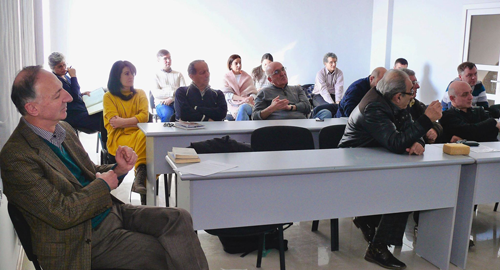
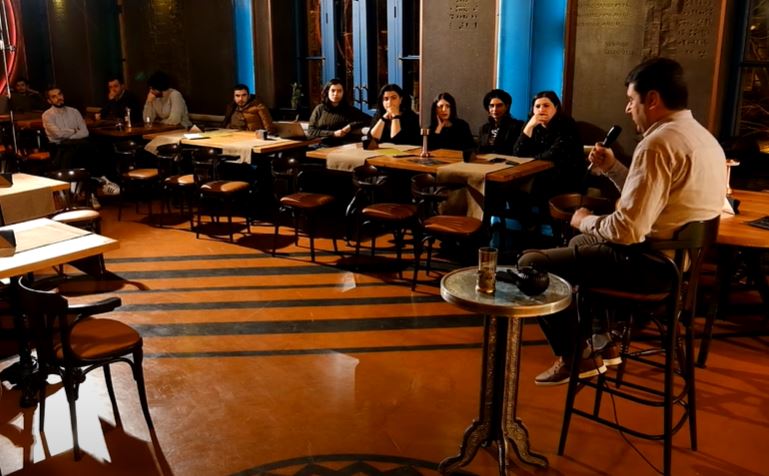
Նկար 1. ՀՀ ԳԱԱ-ի ժողովը Ազգային GRID ցանցի վերաբերյալ

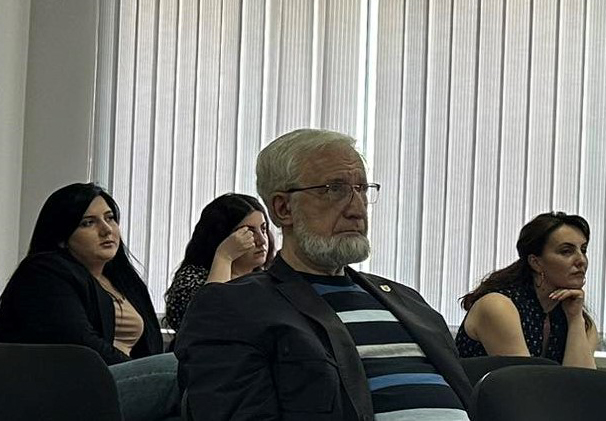
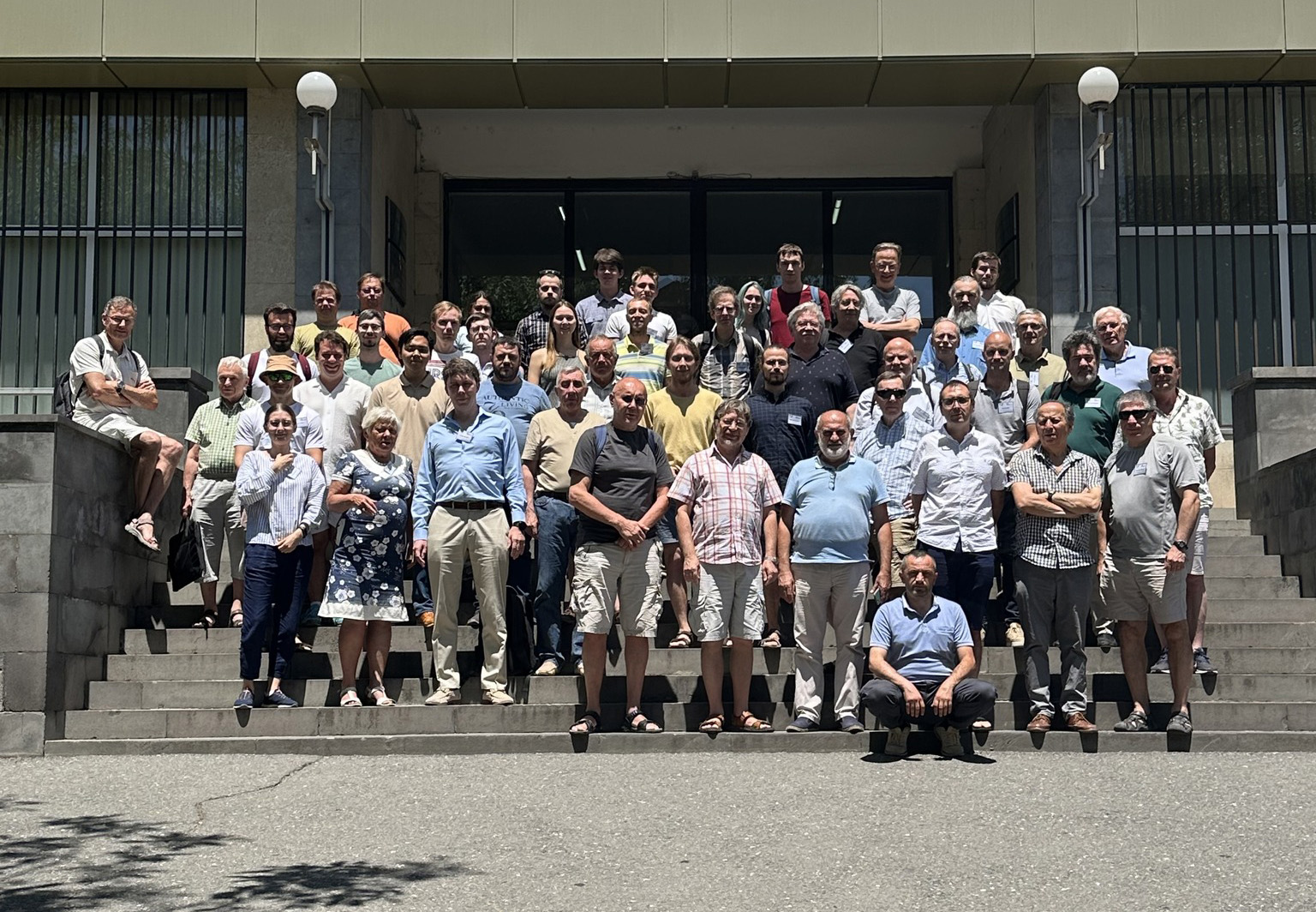
Նկար 2. ՀՀ նախարարությունների, գիտական և կրթական կազմակերպությունների ներկայացուցիչները ՀՀ ԳԱԱ-ի ժողովում Ազգային GRID ցանցի վերաբերյալ

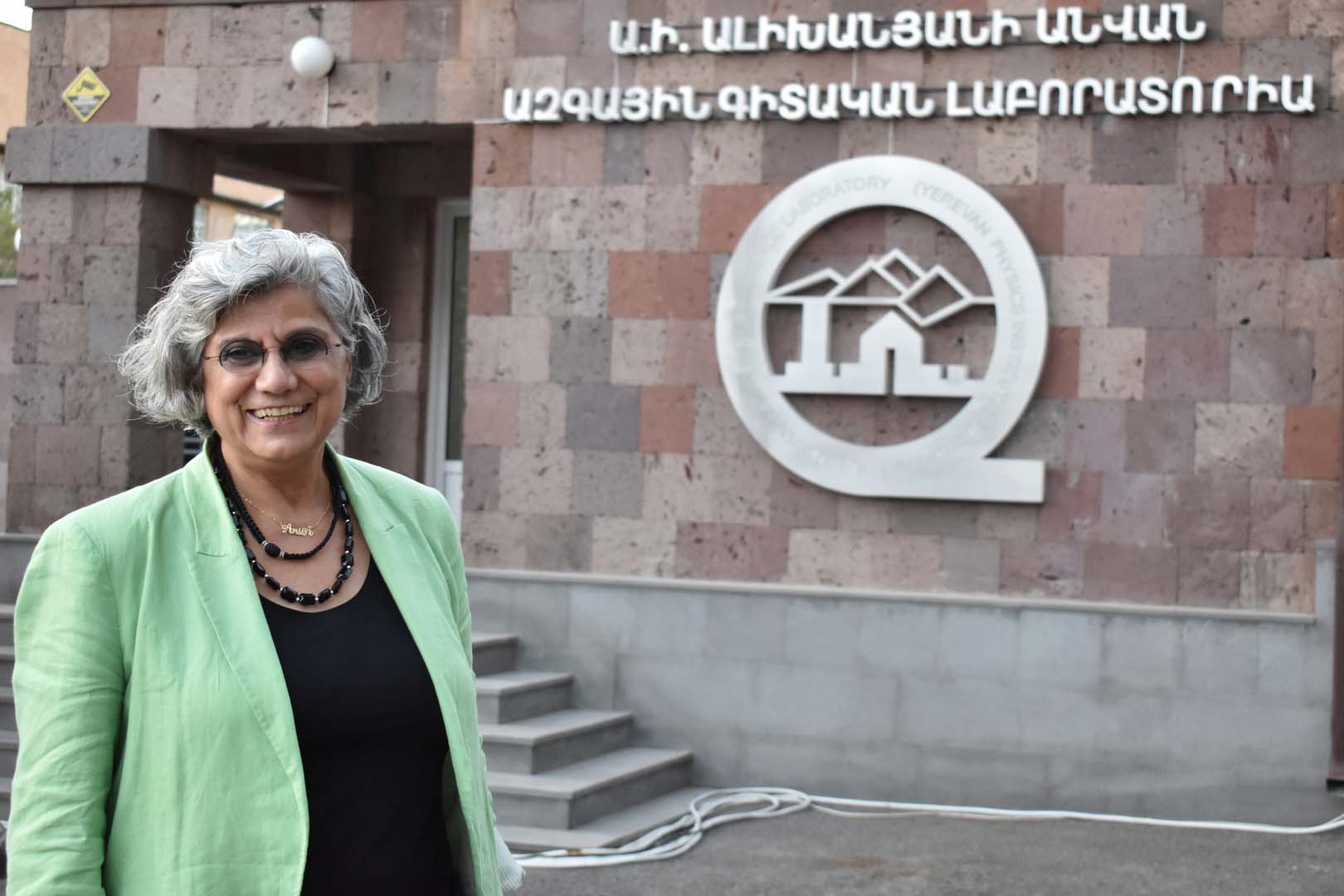
Նկար 3.ԵրՖԻ-ի մասնաշենքը 2010թ փետրվարին
Прибыл
Как передает телекомпания "Мир", первый заместитель председателя правительства России Игорь Шувалов прибыл в Ереван. Визит носит однодневный характер.
За чем направило руководство
Как сообщает Deltablog, первый вице-премьер правительства России Игорь Шувалов обсудил с руководством Армении вопросы взаимодействия в рамках СНГ и перспективы двусторонних российско- армянских отношений. "Руководство направило меня сюда, в Ереван, чтобы обсудить вопросы взаимодействия в рамках СНГ, поскольку Россия в этом году председательствует в Содружестве", - сказал Шувалов на встрече с премьер- министром Армении Тиграном Саркисяном.
Политики о науке
Как сообщает Новости Армении- NEWS.am, учитывая, что 2010 год объявлен в СНГ годом науки и новаторства, собеседники затронули также вопрос реализации совместных мероприятий в этом направлении. В частности, было отмечено, что уже проводятся совместные исследования в области биохимии, нейрохимии, молекулярной биологии, медицинской генетики, физики и в других областях. Были обсуждены также перспективы развития в Армении ядерной медицины и создания армяно-российского инновационного центра. Саркисян подчеркнул, что развитие высоких технологий является одним из приоритетов экономики Армении, и наличие сформированных традиций дает большую возможность углубления взаимовыгодного сотруд-ничества.
Вновь про углубление отношений
Aysor.am информирует, что в ходе встречи стороны обсудили вопросы углубления экономического развития, армяно-российских отношений. Собеседники указали на важность сотрудничества в сфере энергетики, транспорта, единой миграционной политики. И.Шувалов также представил деятельность формирующегося между Россией, Беларусью и Казахстаном таможенного союза.
Позитив да и только Panorama.am сообщает, что Игоря Шувалова сегодня принял также президент Армении Серж Саргсян. С точки зрения развития армяно-российских отношений глава государства счел 2009 год очень продуктивным и сказал: "Мы достигли прогресса практически во всех сферах. 2010 год мы также начали очень интенсивно. Уже состоялись две встречи с президентом России, в январе в Армении находился глава МИД России, сейчас прибыли Вы. Мы оптимистично настроены и считаем, что должны укрепить наши отношения последовательной ежедневной работой", - сказал он. В свою очередь, первый заместитель председателя российского правительства также отметил, что двусторонние связи между Россией и Арменией развиваются позитивно.
http://regnum.ru/news/1250774.html;
![]()
COSMIC STATION Bettina Timm GERMANY, 2008 / DURATION: 30' Mount Aragats is the highest in Armenia. At a 3,500 metres height, what is left of a prestigious Soviet project is a cosmic rays monitoring station. This institute used to gather the best physics scholars with the goal of studying the secrets the universe is made of. Olver a hundred women and men used to live there, looking for information on distant galaxies and the particles created by cosmic rays. Most researchers left when funds ran out with the demise of USSR. Yet, incredibly, some Armenian scholars still resist on this peak, living like ghosts in the old buildings, left in the cold, forgotten by the world and the institutions, only supported by their faith in science and passion for research. Watch the trailer |
The Armenian diaspora played a crucial role in Armenia's independence. Is this true also for the Institute that you direct?
In the year 2000, Armenian-Americans from California, Massachusetts and Michigan established a Cosmic Rays Division Friends Organization to support our research and our scientists. These initiatives were coordinated by Anahid Yeremian, a physicist from SLAC National Accelerator Laboratory in Stanford. The funds they donated were transferred via special projects of the National Foundation of Science and High Technologies (NFSAT), chaired by Harut Karapetyan. In the beginning, we used the funds to support our scientists and students, to buy equipment, and to maintain operation of the high-altitude station. In recent years, these expenses have been covered by the CRD research grants and the diaspora funds have been primarily used for the repair of infrastructure and of buildings at high-altitude research stations.
How do you judge the level of scientific research in modern-day Armenia?
Still high, but fast decaying.
What is your greatest fear for the future, and what is your greatest hope?
The level of education is also decaying very quickly and I’m afraid we may not get the minimum amount of students required to continue our projects in the future.
Our greatest hope is that there are students currently working at CRD who are really devoted to physics. Another hope is that the government finally seems to recognize that if they forget about science again, in a couple of years, there will be nothing to remember.
COST is one of the European Union (EU) most successful instruments to promote scientific projects on the European level. There are hundreds of COST projects in numerous fields of science with thousands researchers from all the European and non-European countries (unfortunately only 2 from Armenia) making joint researches most important to the EU projects. Twice a year meetings are held for the COST country representative to exchange results and plan new investigations, short visits, etc. Recently a new program has launched for the young Phd, postdoctoral researchers: to provide up to 3,000 euro for participation in the conferences. At the Brugge meeting Cosmic Ray Division (CRD) was accepted as a non-COST Institute to join the ES0803 Action. The COST action also planned Space Weather School in Trieste in October 2010.
The traditional Space Weather week was also held in Brugge, an ancient Belgian town with old narrow streets and channels full of beautiful 3-storeyed old buildings and toll chapels (see CRD picture gallery for details). The conference was focused on the creation of the commercial Space Weather forecasting services, crucial for the Space Exploration. The motto of the conference is to provide right information at the right time to the right people to make right decisions! Moving from physics to monitoring and forecasting.
Thomas J.Bogdan, director of the NOAA's Space Weather Prediction Center presented the joint NOAA-Air Force Weather Agency (AFWA) Space Weather Prediction Testbed project, a numerical heliospheric solar storm propagation model (the Geospace Response Model - GRM), that will dramatically enhance the lead time for the prediction of the onset of geomagnetic storms from the current 20 to 50 minutes, provided by NASA's Advanced Composition Explorer spacecraft, out to one to four days.
The GRM consists of the following parts:
Ability to respond to the space weather community expeditiously and build a strong trust relationship within the community is planned by 2012. Transition from models design, verification and validation to commercial operation is planned in 2010-2018.
The director of the ESA’s Space Situational Awareness (SSA) Project, J.P.Luntama, informed that the overall objective of the project is to provide timely and quality data, information, services and knowledge regarding the environment, the threats and the sustainable exploitation of the outer space surrounding the planet Earth. SSA serves the implementation of the strategic missions of the European Space Policy based on the peaceful uses of the outer space by all states, by supporting the autonomous capacity to securely and safely operate the critical European space infrastructures. The SSA preparatory program started in 2009 and will continue until 2011. The aim of the preparatory program includes a number of precursor services in the areas of Space Surveillance, Space Weather and Near Earth Objects (NEOs). The Space Weather (SWE) segment of the SSA will provide user services related to the monitoring of the Sun, the solar wind, the radiation belts, the magnetosphere and the ionosphere. These services will include near real time information and predictions about the characteristics of the space environment and space weather impacts on man- made systems, and a permanent database for analysis, model development and scientific research. These services are aimed at supporting for example spacecraft designers, spacecraft operators, human space flights, users and operators of transionospheric radio links, other SSA segments, and the space weather research community. The precursor SWE services will include a selected subset of these services based on pre-existing space weather applications. Spanish, French and German Space Weather programs were also presented. At the poster session numerous facilities and methods were presented and discussed. I presented the concept and the first results of the SEVAN world-wide network of hybrid particle detectors, measuring 3 species of the secondary cosmic rays. The considerable advantage of SEVAN type detectors upon the 60 years old neutron monitors is as follows:
Significantly enlarge the reliability of Space Weather alerts due to detection of 3 particle fluxes instead of only one in existing neutron monitor and muon telescope world-wide networks.
Detection of electrons and gamma-quanta from showers generated by powerful natural accelerators operating during thunderstorms – research of Detection of operation of the relativistic feedback accelerator in low atmosphere.
During the conference we also performed several meetings with Rainer Hippler, Lev Dorman and Lev Pustil’nik to form a consortium for the new FP7 programme on the Space Weather forecasting based on SEVAN network.

At DESY I conducted several meetings with DESY directorate members, met HERMES, H1 groups, examined the ARGUS detector dismounted by the YerPhI technicians and gave a seminar on the recent cosmic ray research.
During the meetings with new DESY research director Joachim Mnich and deputy research detector Manfred Fleischer the ongoing joint projects were discussed and a firm intention to continue and enlarge the collaboration between YerPhI and DESY was confirmed. YerPhI got invitation to actively participate in the last high energy physics experiment at DORIS rings - the OLYMPYS* experiment. The funds from EU and USA are already allocated, the preparatory works already started (by YerPhI group), MOU planned to be signed in the end of 2009 and experiment is planned at 2012. By that time a lot of preparatory simulations should be done to be sure that all parameters of experiment are chosen optimally. 2012 is the last year of DORIS operation, therefore, there will be no time to reuse the beam and correct possible mistakes. A decision was made to donate YerPhI large computer cluster for the GRID operation. The transportation of computers was planned for the Spring, 2010.

During the meeting with the former chair of DESY Directors board Albrecht Wagner we discussed the situation in YerPhI after external board meeting in July 2009. Albrecht Wagner, one of the most active commission members, once again emphasized the necessity to urgently form a Permanent External Board for YerPhI. He claimed that without this board he will not be able to run DESY.
During the visit to the HERA west hall the exhibition of the HERA experiments detectors and the new workshop for particle detector assembling were demonstrated to me. During recent “open doors” at DESY more than 13,000 Hamburg citizens visited specially prepared expositions at DESY. It is a good example for YerPhI: we have to prepare the exhibition of our facilities, invite students from all the Armenian universities and schools to interest the new generation in high energy physics. In contrast with YerPhI the age structure of DESY is balanced and they have no problems to incorporate students in current activities.


* Striking differences have been observed in the ratio between the electric and magnetic proton form factors as function of Q2, either from measurements using the Rosenbluth separation method or using polarisation transfer. Two-photon exchange (TPE) effects are one possible explanation for this discrepancy. The most elegant and direct way to measure the TPE is to measure the ratio of elastic electron-proton and positron-proton cross-sections, where the contribution enters with different sign.Such an experiment, now named OLYMPUS, has been proposed to be performed at the DORIS storage ring at DESY utilizing the BLAST detector. The details of experiment and YerPhI participation in it will be presented by N.Akopov in Spring 2009.
1. On November 4 I was among the delegation accompanying the PM of Armenia Tigran Sargsyan in his visits to Stanford Linear Accelerator Center (SLAC) and Berkley University. At SLAC Mr. Sargsyan met with Director of SLAC – Dr. Persis Drell, Associate Lab Director - Dr. Dale Knutson, Director of Accelerator Research department Dr. Tor Raubenheimer, and Armenian students of the Stanford university. PM was introduced to the history of SLAC, ongoing research and development of new accelerators for powerful light sources and for medicine. Also, the status of national lab (SLAC present status) was explained and discussed. During the meetings with the Armenian students and the representative of the Silicon valley Armenian diaspora in Berkeley, PM talked over the RA politics to support the education of Armenian students in the country and abroad in world-best universities. The new organized National Competitiveness council and Luis foundation will coordinate projects in tourism, education and healthcare. The Yerevan Physics institute, to be turned to National lab, will actively participate in nuclear medicine establishing in Armenia.
2. On November 6 and 7 I participated in the plenary and section sessions of the ArmTech congress. Plenary sections were very interesting; the presidents and CEOs of big companies based in the Silicon Valley presented a broad picture of the high tech industry development and possibilities of Armenia to take part in it. Unfortunately, ArmTech section sessions were not much populated and business contacts were very rare. Seem, that Armenian presenters, despite very interesting projects, were not suffisiently prepared for business contacts. They did not elaborate business schemes to involve private capital (asking for loans, selling part of business, etc...) and they were not ready to share the business with private people to recieve investments. The estimates of the expected profit and of the product price were also a bit arbitrary. In my plenary presentation “Applied Cosmic Ray Physics: Science-Technology-Innovation" I tried to demonstrate the connections between fundamental science and innovation illustrating the Space Weather research in Cosmic Ray Division of Yerevan Physics Institute. It is a new emerging scientific field, as well as a new emerging commercial service. Fundamental science in this case is directly creating a new innovative technology. In the Space Weather research we have performed fundamental research, technological know-how and elaborated business schemes in one and the same project, that is very challenging. However, this has resulted from a big demand in new innovative technologies and products necessary for the overcoming of the economical crisis. The ArmTech congress has the goals to develop knowledge based economy in Armenia via business/academia cooperation invoking the intellectual capital and entrepreneurship experience from Diaspora. This goal can be achieved through improvement of education at all levels; building strong Internet presence; focusing on programs to end up on the products or services; and by reforming and creating transparent government agencies.

Accelerator Division at SLAC:
3. Meeting with Dr. Sami Tantawi, head of the group of the Advanced Microwave Technology Research (ATR), 10 November, 2009. Different applications of the accelerator technologies were discussed: The total volume of the accelerator production industry in the USA reached 3.5 bln in 2008; most popular are small 7-8 MeV electron accelerators for cancer treatment. 3,000 of such accelerators have already been installed in the USA. 60% of the world market of these accelerators is occupied by the Silicon Valley based Varian firm, producing one accelerator per day. Another promising application is the welfares cutting technology - proton beam by charging the chip can cut on atomic length scale - economy up to 70% of silicon; very important for the 60 nm technology. In 2008, 30% of food in the USA was exposed to radiation sources (sterilized) to survive at least 10 time more. All tires in the USA also passed radioactive treatment to serve longer.
4. At the meeting on November 11 with SLAC Director of Accelerator Research department Dr. Tor Raubenheimer participated also senior ISTC manager Dr. Karen Bunyatov, academician Robert Avagyan, YerPhI director A.Chilingarian.
T.Raubenheimer informed about the possible joint institutions projects connected with applications of the accelerator technologies in medical diagnostics and treatment. A mutual interest was expressed in high current and compact electron linear accelerators (LINACs) in the energy range of 30-40 MeV for medical isotopes production. New compact LINACs are under design now . Robert Avakian informed about the project of generating the Tc-99m for SPECT diagnostic on electron linear accelerator which is now under test at YerPhI. New possibilities for Tc-99m separation now are also under investigation in his group. Karen Buniatov expressed interest of ISTC in the YerPhI sustainability plan that’s major part is the development of the accelerator applied technologies. Both sides stated interest in collaboration and decided to prepare a memorandum of understanding (MOU). The same day Armenian delegation visited new SLAC facility.


The Linac Coherent Light Source (LCLS) provides the world's brightest, shortest pulses of laser X-rays for various fundamental and applied studies. It will give scientists an unprecedented tool for studying and understanding the arrangement of atoms in semiconductors, ceramics, polymers, catalysts, plastics, and biological molecules, with wide-ranging impact on advanced research in other fields.
The LCLS X-ray beam is brighter than any other human-made source of short-pulse, hard X-rays. Initial tests produced laser light with a wavelength of 1.5 Angstroms, or 0.15 nanometers—the shortest-wavelength, highest-energy X-rays ever created by any laser. To generate that light, the team had to align the electron beam with extreme precision of 5 micrometers per 5 meters.
Unlike conventional lasers, which use mirrored cavities to amplify light, the LCLS is a free-electron laser, creating light using free-flying electrons in a vacuum. The LCLS uses the final third of SLAC's two-mile linear accelerator to drive electrons to high energy and through an array of "undulator" magnets (33 Wiglers, only 12 used) that steer the electrons rapidly back and forth, generating a brilliant beam of coherent X-rays.
5. On November 10 I held a seminar for the Stanford/KAvli particle astrophysics group on the recent discovery of powerful electron accelerator operating in lower atmosphere, named “Thunderstorm Correlated Fluxes of electrons, Gammas and Neutrons Observed at Mountain Altitude”. The same seminar was given also for the solar physics group of the Lockheed Martin's Advanced Technology Center in Palo Alto.